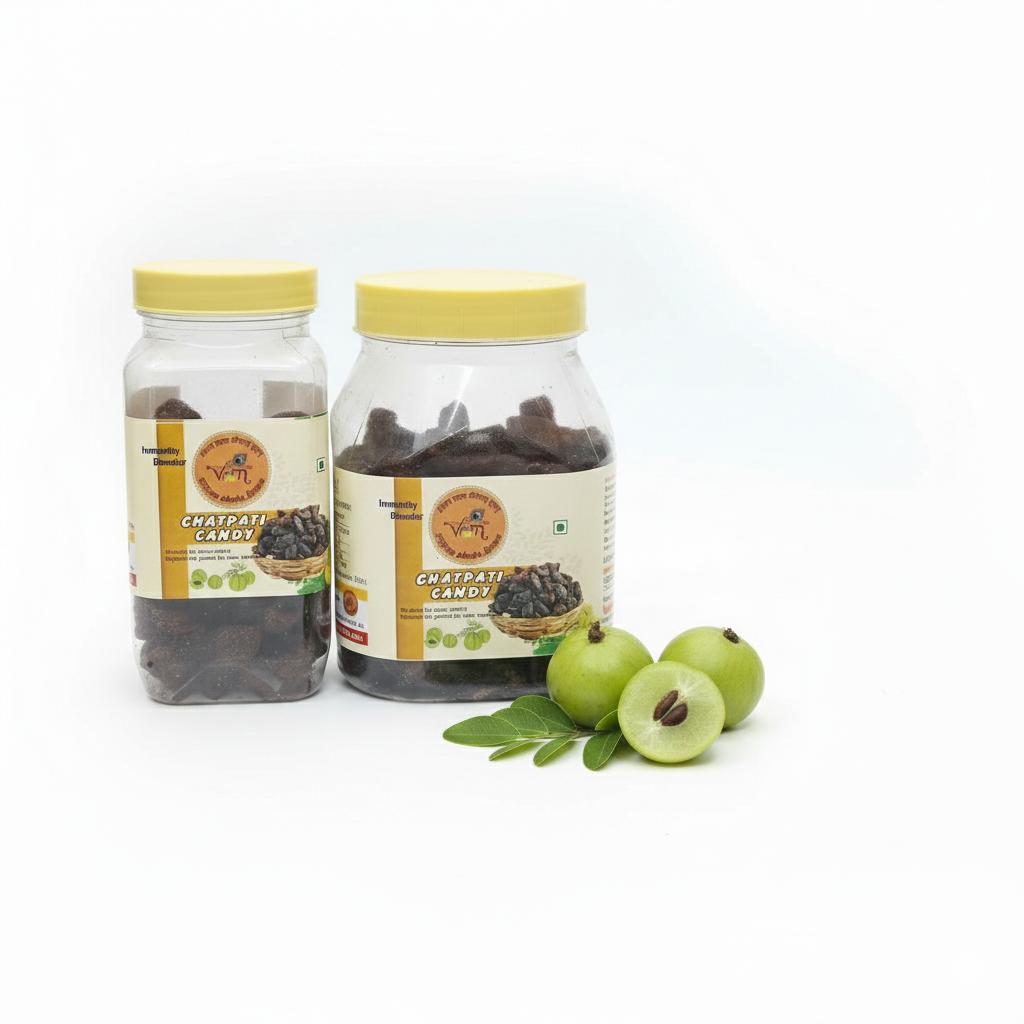
Amla Candy Benefits — Why This Ancient Superfood Is India's Best-Kept Health Secret
By Vrindavan Aushadhiya Misthan Team
My grandmother used to keep a small clay jar of amla candy on the kitchen shelf. Every morning, before tea, before breakfast, before anything else, she'd take one and chew it slowly. She lived to ninety-two. Her hair turned grey only in her late eighties. Her digestion never gave her trouble. I assumed it was genetics. After two decades of making herbal sweets in Haridwar — watching customers return, watching what works — I've come to understand she was simply following a very old prescription.
Amla candy benefits are not a wellness trend discovered by a nutritionist in 2020. They're documented in texts written 2,500 years ago, confirmed by modern research, and quietly understood by every Indian grandmother who ever kept a jar of the stuff on her kitchen shelf.
If you've been wondering whether amla candy is genuinely useful or just cleverly marketed, here's an honest answer.
What Is Amla? The Fruit Behind the Candy
Amla (Phyllanthus emblica, also known as Indian Gooseberry or Amalaki) grows across the Indian subcontinent — from the Himalayan foothills of Haridwar and Rishikesh down through the central and southern plains. The fruit is roughly the size of a small marble, pale green to light yellow, and intensely tart when fresh.
That tartness is important. It means the tannins — gallic acid, ellagic acid, chebulic acid — are present and intact. These compounds are responsible for most of amla's documented health properties, and they're the first thing destroyed when a manufacturer overprocesses the fruit at high heat.
What 100g of fresh amla actually contains:
- Vitamin C: 450–700 mg (8–10 times more than orange)
- Gallic acid and ellagic acid: among the most potent antioxidant tannins found in any food
- Dietary fibre: 3.4 g
- Iron: 0.31 mg
- Calcium: 25 mg
- Natural pectin: supports gut health
- Zero fat, minimal sodium
The Vitamin C figure deserves emphasis. One medium amla (roughly 50g) contains more Vitamin C than twenty medium oranges. And unlike the synthetic ascorbic acid in supplement tablets, amla's Vitamin C comes bound to tannins and bioflavonoids that meaningfully improve how your body absorbs and uses it. Bioavailability matters.
What Charaka Samhita Says About Amalaki
Charaka Samhita, the foundational clinical text of Ayurveda, does not treat amla as a footnote. In the Chikitsasthana section on Rasayana (rejuvenation therapies), amalaki is named the single most important rejuvenating substance in the entire Ayurvedic materia medica.
Charaka states: "Pathyam amalakam nityam" — Amla should be consumed daily as part of healthy living. Not occasionally when you feel unwell. Every day.
The classical indication list for amalaki covers:
- Prameha (diabetes and urinary metabolic disorders)
- Kasa and shwasa (respiratory conditions, cough)
- Kamala (jaundice and liver conditions)
- Nidranash (sleep difficulties)
- Jara-vyadhi (ageing-related conditions)
- Keshya (hair nourishment)
- Chakshushya (eye health)
- Raktashodhak (blood purification)
This is a broad list — and it reflects the fact that amla works at a cellular level, with antioxidants protecting tissues across multiple organ systems simultaneously. The ancients observed these effects clinically over generations. Modern biochemistry has explained the mechanisms.
12 Amla Candy Benefits, Explained Without Exaggeration
1. Immunity Vitamin C supports white blood cell production and speeds immune response. Amla's Vitamin C is better absorbed than supplement tablets because of co-occurring bioflavonoids. During Haridwar's monsoon season, when waterborne infections increase and respiratory viruses circulate, we consistently see people specifically asking for amla candy. There's a reason.
2. Digestion and Gut Health Amla is deepana (kindles digestive fire) and pachana (aids digestion) in Ayurveda. The tannins reduce gut inflammation, support bowel regularity, and protect the mucosal lining. One piece after a heavy meal is more directly useful than most probiotic supplements.
3. Liver Protection Charaka calls amla yakrit-uttejak — a liver stimulant and protector. Modern research has demonstrated hepatoprotective effects in studies using amla extract. If you're on long-term medications, eat oily food regularly, or drink occasionally, consistent amla consumption provides measurable liver support.
4. Blood Sugar Management Amla has been shown to inhibit alpha-amylase and alpha-glucosidase — the enzymes that break down carbohydrates into glucose — thereby slowing glucose absorption and reducing post-meal blood sugar spikes.
To be direct: amla candy is not a medical treatment for diabetes. We don't make that claim, and you should be suspicious of any sweet shop that does. But as a daily habit, it supports more stable blood sugar in a way that most snack foods simply don't.
5. Cholesterol and Heart Health Amla reduces LDL oxidation — the process that creates arterial plaque. Clinical studies have shown meaningful cholesterol improvements with regular amla consumption over 8–12 weeks.
6. Anti-Ageing Free radical damage to cells drives visible ageing and age-related disease. Amla's antioxidant capacity is extraordinary — among the highest measured in any food. The rasayana (rejuvenating) classification in Ayurveda isn't poetic metaphor. It reflects effects that have been observed across millennia.
7. Eye Health Vitamin A precursors and antioxidants in amla protect the retina from oxidative stress. Age-related macular degeneration has a significant oxidative component, and regular amla consumption addresses this directly.
8. Hair Strength and Greying Prevention Amla is keshya — hair-nourishing — in Ayurveda. Iron and Vitamin C in combination support keratin production and melanin synthesis. Several of our long-term customers specifically mention improved hair quality after consistent amla candy consumption. We can't make a medical claim, but the pattern shows up too often to dismiss.
9. Cooling in Summer Amla is pitta-shamak — it reduces excess heat in the body. If you experience burning eyes, skin rashes, excess thirst, or irritability in summer, amla addresses these directly. April through June is consistently our highest demand period for amla products.
10. Detoxification Support Amla supports the liver's Phase 1 and Phase 2 detoxification pathways — the biochemical processes by which the liver identifies and eliminates environmental toxins. In an environment full of food additives and air pollutants, this support is genuinely useful.
11. Oral Health The tannins in amla have natural antibacterial properties. Regular consumption reduces harmful oral bacteria, supports gum health, and — reported by many regular customers — maintains fresher breath throughout the day.
12. Appetite Recalibration Less discussed but consistent: people who build a daily amla habit often find that plain food tastes better, that they need less sweetness to feel satisfied, and that cravings for intensely processed food reduce over time. The mechanism isn't fully understood, but the pattern is real.
How Amla Candy Is Made at Vrindavan Aushadhiya
Not all amla candy is the same product. The gap between authentic amla candy and the industrial version sold at railway station kiosks is significant.
The industrial version: Amla is boiled in concentrated sugar syrup, dried, and coated in a thick sugar shell. The high-temperature boiling destroys most Vitamin C. You're essentially eating a sugar drop with trace amla flavour. The bright colours tell you something's been added.
Our process at Vrindavan Aushadhiya Misthan:
Sourcing: We source fresh amla from orchards in the Haridwar-Rishikesh belt during peak season (October–February). Short supply chain means shorter time between harvest and processing — nutritional integrity degrades fast after picking.
Preparation: Fresh amla is washed, pricked to allow even treatment, and soaked overnight in rock salt brine. This reduces bitterness without destroying nutrition.
Slow cooking: We use a low-heat, extended-time method rather than boiling in concentrated syrup. Lower temperatures preserve significantly more of the heat-sensitive Vitamin C and volatile aromatic compounds.
Drying: Sun-drying on clean racks, or low-temperature mechanical drying. Not industrial high-heat dryers.
Finishing: A light mix of salt, black salt (kala namak), and mild spice. No artificial colours, no preservatives, no synthetic flavouring.
The result tastes like amla — sour and astringent first, then a spreading sweetness, then that characteristic cooling sensation. If the amla candy you're eating is overwhelmingly sweet from the first bite with sourness as a faint background note, the fruit has been overprocessed. The authentic product hits you with sour first.
Amla Candy vs Regular Candy
| Factor | Authentic Amla Candy | Commercial Sugar Candy |
|---|---|---|
| Primary ingredient | Whole amla fruit | Sugar, glucose syrup |
| Vitamin C | Retained | Absent or trace |
| Antioxidants | High (tannins intact) | None |
| Artificial colour | None | Commonly added |
| Dietary fibre | Yes | None |
| First taste | Sour, then astringent, then sweet | Immediately sweet |
| Net health effect | Positive, documented | Neutral at best |
This is not us claiming our amla candy is "sugar-free" or "zero calorie." It contains sugar or jaggery. But the comparison with conventional candy — or even conventional sweets like Rasgulla or Gulab Jamun — is stark.
The Four Types of Water in Ayurvedic Food Preparation
Water is foundational to how any food is made. Ayurveda classifies water into four types — and this classification explains why location and process matter even when the ingredients are nominally identical.
Bhumi Jal (भूमि जल — Groundwater): Percolated through earth and rock, mineral-rich, guru (heavy) and snigdha (unctuous). Nourishing, but heavy for compromised digestion.
Antariksha Jal (अंतरिक्ष जल — Rain Water): The purest form in Ayurvedic understanding — laghu (light), tridosha-shamak (balancing to all three constitutions), with no pre-existing mineral load. Charaka specifically recommends it for medicinal preparations.
Nadi Jal (नदी जल — River Water): The Ganga's water has documented natural antimicrobial properties. Pavitra (purifying) and laghu (light).
Phala Jal (फल जल — Fruit Water): The moisture naturally contained within fruits — the juice inside a fresh amla, the water content of a ripe guava. Ayurveda considers this the most sattvic (pure, life-promoting) water type. It carries the fruit's own enzymes, electrolytes, and bioactive compounds in perfect proportion.
When we use whole fresh amla rather than amla powder or concentrate reconstituted with tap water, we preserve the phala jal of the fruit. That internal moisture carries compounds no external water source can replicate. See our Heritage page for how Ayurvedic principles guide our production.
Why Haridwar Is the Right Place for Amla Products
Haridwar sits at the transition between the Himalayan foothills and the Indo-Gangetic plains. The amla orchards in the surrounding Haridwar-Rishikesh-Roorkee belt produce fruit with particularly high tannin content. We've sourced from these orchards for years and can taste the difference against amla from further south.
Short supply chain matters here — fruit processed within days of harvest, rather than weeks or months, starts with better nutritional integrity. As the best sweet shop in Haridwar for herbal and fruit-based sweets, we've built direct relationships with specific growers whose practices we trust. A factory buying amla by the containerload can't replicate this. Explore our products at our Bhandar page.
How to Choose Quality Amla Candy — 5 Signs
1. Colour: Natural amla candy is light brown, greenish-brown, or pale yellow. Bright red or vivid orange means artificial colouring.
2. First taste: Sour and astringent before sweet. If it's overwhelmingly sweet from the first second, the amla content is minimal.
3. Texture: Slight chewiness from intact fruit fibre. Pure sugar candy is uniformly brittle or crystalline.
4. Aftertaste: Good amla candy leaves a cooling sensation in the throat and a faint metallic-sweet note. This is the gallic acid working.
5. Ingredients: Amla (or Indian Gooseberry) should be the first ingredient. If sugar or glucose syrup is listed first, you have your answer.
Amla Candy for Children
Appropriate from age two or three onward — and far preferable to synthetic candy. The tartness can be an initial barrier for children raised on very sweet processed food. Start with the sweeter variant if needed.
One caution: amla has a mild laxative effect at high quantities. One or two pieces per day for children is appropriate; we don't recommend giving a whole bag.
Where to Buy Authentic Amla Candy in Haridwar
Amla candy is sold everywhere in Haridwar — at railway station kiosks, near Har Ki Pauri, at ghat stalls. Most of it is the industrial version: bright colours, intensely sweet, minimal real amla.
At Vrindavan Aushadhiya Misthan — the best sweet shop in Haridwar for herbal sweets — our amla candy is available at all three locations:
Jwalapur Store (D-10), Subhash Nagar, Haridwar | B-13, B Cluster, BHEL, Haridwar | Navoday Nagar, near Butterfly School Gate No. 2
Hours: 8 AM to 9 PM daily | WhatsApp: +91-7705072989
We also carry Amla Barfi and Amla Chatpati Candy. Browse our full Bhandar for everything we make. Read more on Why Vrindavan Aushadhiya Stands Out.
FAQ: Amla Candy Questions Answered Honestly
Q1. How many pieces per day? 2–4 pieces for adults is a sensible daily habit. 1–2 for children. More is not necessarily better — balance over excess.
Q2. Can diabetics eat amla candy? Our jaggery-based amla candy is significantly better than conventional sweets for people managing blood sugar. The amla itself supports blood sugar stability. But we're not a medical authority — consult your doctor. We won't make claims we can't back.
Q3. When is the best time to eat it? Morning before breakfast is the Ayurvedic prescription. After meals is the second-best option. Not immediately before bed.
Q4. Has the Vitamin C survived processing? In properly made amla candy — low heat, slow process — meaningful Vitamin C is retained. The tart, astringent taste is your indicator. No tartness = no intact nutritional profile.
Q5. Is your amla candy sugar-free? No. It contains either cane sugar or jaggery. But the sugar content is controlled, the fruit is real, and the comparison with Rasgulla or Gulab Jamun is not close.
Q6. How long does it keep? 3–4 months in a cool, dry place. Refrigeration extends to 6 months. If the texture becomes wet and sticky, discard it.
Vrindavan Aushadhiya Misthan — Haridwar's best sweet shop for herbal and traditional sweets. 3 locations | Open 8 AM to 9 PM | WhatsApp: +91-7705072989
आंवला कैंडी के फायदे — भारत का सबसे पुराना सुपरफूड
वृंदावन औषधीय मिष्ठान टीम
मेरी दादी हर सुबह नाश्ते से पहले एक आंवला कैंडी खाती थीं। उन्होंने 92 साल की उम्र तक स्वस्थ जीवन जिया। दो दशकों से हरिद्वार में औषधीय मिठाइयाँ बनाने के बाद मुझे समझ में आया कि वो आयुर्वेद का सबसे पुराना नुस्खा चुपचाप अपना रही थीं।
आंवला क्या है?
आंवला (Phyllanthus emblica) — भारतीय करौंदा — हिमालय की तलहटी से लेकर दक्षिण भारत तक पाया जाता है। हरिद्वार के आसपास के बागानों में उगने वाला आंवला विशेष रूप से टैनिन-समृद्ध होता है।
100 ग्राम आंवले में:
- विटामिन C: 450–700 मिलीग्राम (संतरे से 8–10 गुना अधिक)
- गैलिक एसिड और एलेजिक एसिड: शक्तिशाली एंटीऑक्सिडेंट
- आहार फाइबर: 3.4 ग्राम
- लोहा, कैल्शियम, फास्फोरस
चरक संहिता में आंवला
चरक संहिता में आंवले को सर्वश्रेष्ठ रसायन (पुनर्जीवन औषधि) बताया गया है।
"पथ्यम आमलकं नित्यम" — आंवला का सेवन प्रतिदिन करना चाहिए।
चरक ने इसे इन रोगों में उपयोगी बताया: प्रमेह (मधुमेह), कास-श्वास, कामला (यकृत), जरावस्था (वृद्धावस्था से रक्षा), केश्य (बाल), चक्षुष्य (नेत्र)।
आंवला कैंडी के 12 प्रमुख फायदे
- रोग प्रतिरोधक क्षमता: विटामिन C श्वेत रक्त कोशिकाओं का उत्पादन बढ़ाता है
- पाचन: दीपन और पाचन गुण — भारी भोजन के बाद लाभकारी
- यकृत सुरक्षा: यकृत-उत्तेजक गुण
- रक्त शर्करा नियंत्रण: alpha-amylase को रोककर ग्लूकोज़ अवशोषण धीमा करता है
- हृदय स्वास्थ्य: LDL ऑक्सीडेशन कम करता है
- एंटी-एजिंग: असाधारण एंटीऑक्सिडेंट क्षमता
- नेत्र स्वास्थ्य: रेटिना की रक्षा
- बाल: लोहा + विटामिन C मिलकर केराटिन उत्पादन में सहायक
- गर्मी में शीतलता: पित्त-शामक
- प्राकृतिक विषहरण: यकृत के डिटॉक्सीफिकेशन में सहायक
- मुख स्वास्थ्य: टैनिन के एंटीबैक्टीरियल गुण
- स्वाद संवेदनशीलता: मीठे की लत धीरे-धीरे कम होती है
वृंदावन औषधीय में आंवला कैंडी कैसे बनती है
हम ताजा आंवला हरिद्वार-ऋषिकेश क्षेत्र के बागानों से सीधे लाते हैं — अक्टूबर से फरवरी, जब फल सबसे पौष्टिक होता है। धीमी गर्मी की प्रक्रिया से विटामिन C और टैनिन सुरक्षित रहते हैं। कोई कृत्रिम रंग नहीं, कोई परिरक्षक नहीं।
असली आंवला कैंडी पहले खट्टी-कसैली लगती है, फिर मिठास आती है। अगर पहले ही पल से बहुत मीठी लगे तो समझें कि फल की गुणवत्ता से समझौता हुआ है।
क्या यह "शुगर-फ्री" है?
नहीं। हम यह दावा नहीं करते। इसमें चीनी या गुड़ है। लेकिन रसगुल्ले या गुलाब जामुन की तुलना में बहुत कम, और असली फल का पोषण मौजूद है।
हरिद्वार में कहाँ मिलेगी?
वृंदावन औषधीय मिष्ठान — हरिद्वार की सर्वश्रेष्ठ मिठाई दुकान:
- ज्वालापुर (D-10), सुभाष नगर, हरिद्वार
- B-13, B क्लस्टर, BHEL, हरिद्वार
- नवोदय नगर, बटरफ्लाई स्कूल गेट नं. 2 के पास
समय: सुबह 8 – रात 9 | WhatsApp: +91-7705072989
Vrindavan Aushadhiya Misthan — 3 Locations, Haridwar
W3QF+4M Haridwar, Uttarakhand
Visit the Best Sweets Shop in Haridwar
Vrindavan Aushadhiya Misthan — 3 Store Locations · WhatsApp Delivery Available