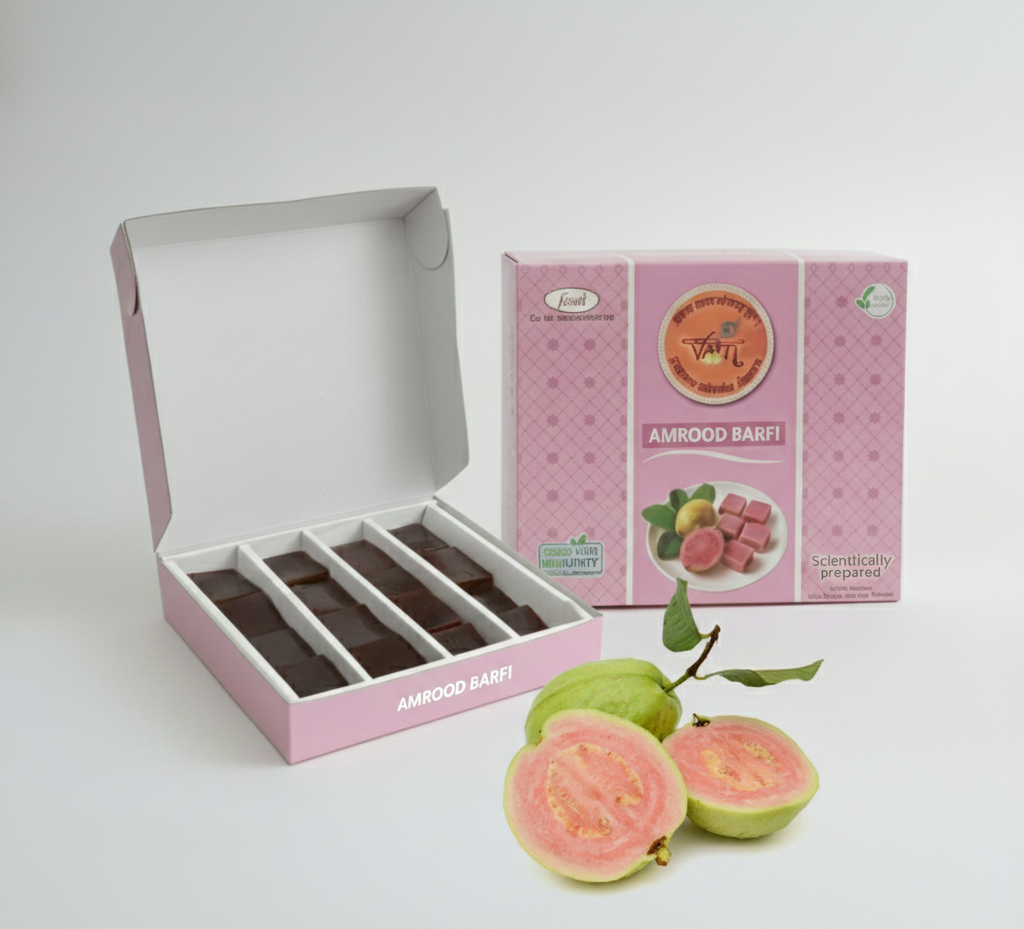
Guava Burfi Recipe — The Haridwar Specialty That Most Sweet Shops Don't Make
By Vrindavan Aushadhiya Misthan Team
Ask someone to name three classic barfi varieties and they'll say kaju katli, besan barfi, maybe coconut barfi. Almost nobody says guava barfi. That's partly because most sweet shops in India simply don't make it — it's harder than it looks, the shelf life is shorter than dry barfi, and customers who've never tasted it don't know to ask.
We started making guava burfi (amrood ki barfi) because guava grows abundantly in and around Haridwar and because the fruit has a nutritional and Ayurvedic profile that's genuinely impressive. The challenge was making a barfi that actually tastes like guava — not a guava-flavoured sugar block, but a sweet that carries the fruit's own character through the cooking process.
This post covers what guava burfi is, why it's nutritionally interesting, a recipe you can try at home, and what makes the version we make at Vrindavan Aushadhiya different from anything you'd produce in your first attempt.
What Is Guava Burfi?
Guava burfi (amrood barfi) is a dense, fudge-like sweet made from concentrated guava pulp, set with a binding agent, and cut into squares — the standard barfi form. Done properly, each piece has a distinctive pink-to-deep-rose colour from the guava flesh, a slightly grainy texture from the fruit fibre, and a fragrance that unmistakably says guava rather than generic sweet.
The challenge of making it well: guava has high water content and high natural pectin, which makes concentration tricky. Concentrate it too fast on high heat and you get a tough, rubbery block. Too slowly and the colour turns brown. The natural pectin can cause uneven setting if temperature isn't controlled. A well-made guava burfi requires attention and patience — which is why most shops don't bother.
Nutritional Profile — Guava vs Traditional Barfi Ingredients
Before the recipe, understand what you're actually eating when you choose guava burfi over kaju katli or besan barfi.
Guava (100g, fresh):
- Vitamin C: 228 mg — among the highest of any common fruit
- Dietary fibre: 5.4 g
- Lycopene (pink guava): 5,200 mcg
- Folate: 49 mcg
- Potassium: 417 mg
- Natural sugars: 8.9 g
- Fat: 0.9 g
Cashew barfi (100g, typical):
- Vitamin C: negligible
- Fibre: minimal
- Fat: 25–30 g
- Added sugar: 40–50 g
- Some protein from cashews
Besan barfi (100g, typical):
- Vitamin C: negligible
- Fat: 15–20 g (ghee)
- Added sugar: 35–45 g
- Some protein from chickpea flour
Guava burfi, made with real fruit pulp and controlled sweetening, brings Vitamin C, fibre, and lycopene to the table. No other barfi variety does this. You're eating a sweet that contributes something nutritionally — not just calories.
Ayurvedic Properties of Guava
Guava (amrud or peru) appears in Ayurvedic texts as:
- Madhura-kashaya (sweet and astringent) in taste
- Shita (cooling) in potency
- Guru (heavy, filling, grounding)
- Vata-pitta shamak — reduces excess Vata and Pitta doshas
The high fibre and pectin content supports regular bowel movement and feeds beneficial gut bacteria. The astringency from tannins has traditionally been used to control loose stools — classical Ayurveda prescribes guava leaf decoction for diarrhoea. The lycopene (modern knowledge, but consistent with Ayurveda's observation that red/pink fruits support rakta dhatu) has potent antioxidant effects.
Charaka's amra-varga (fruit classification) does not single out guava specifically by our modern name, but regional Ayurvedic traditions have used guava therapeutically for centuries, and the fruit fits clearly within the laghu phala (light fruit) classification.
Home Recipe — Guava Burfi You Can Make
This recipe makes approximately 20–25 pieces.
Ingredients:
- 500g ripe guava (pink-flesh variety has better colour and sweetness)
- 150g sugar, or 120g jaggery powder for the jaggery version
- 2 tablespoons ghee
- 1/4 teaspoon cardamom powder
- 1/4 teaspoon black salt (kala namak) — optional but recommended
Method:
Step 1 — Prepare the guava: Wash thoroughly. You can peel for a smoother texture, or leave skin on for more colour and nutrition (traditional method). Quarter and deseed. Mash or blend to a rough pulp — some texture is good, completely smooth is fine too.
Step 2 — Reduce the pulp: In a heavy-bottomed pan (steel or iron, not non-stick — you need the heat retention), cook the pulp on medium flame with continuous stirring. You're cooking out water — reducing approximately 500g of pulp to about 200g of concentrated, thick paste. This takes 20–35 minutes. Do not rush with high heat or the colour darkens and sugars caramelize unevenly.
Step 3 — Add sweetener: Once pulp has reduced and thickened, add sugar or jaggery. Stir vigorously on medium heat. The mixture will thin briefly when sweetener dissolves — keep cooking until it thickens again.
Step 4 — Add ghee: Add ghee in two additions, stirring completely between each. This gives the burfi its smoothness and helps it release from the pan later.
Step 5 — Test for readiness: Drop a small amount on a cold plate. If it holds its shape without spreading, it's ready. If it spreads, cook further. Add cardamom and black salt at this point and mix through.
Step 6 — Set and cut: Pour onto a greased plate or tray. Smooth to 1–1.5 cm thickness. Allow to cool completely at room temperature — don't refrigerate immediately, as condensation causes surface issues. Once fully set (1–2 hours), cut into diamonds or squares.
Where people go wrong:
- Rushing the reduction → tough, rubbery texture
- Using underripe guava → lacks fragrance, colour, and sweetness
- Not stirring continuously after adding sugar → burns the bottom
- Cutting before fully cooled → pieces won't hold shape
Why the Professional Version Is Different
Your home version can be genuinely good. Here's what distinguishes the version we make at Vrindavan Aushadhiya Misthan — the best sweet shop in Haridwar for fruit-based sweets:
Fruit selection: We source pink-flesh guava specifically for high sugar content, fragrance, and flesh-to-seed ratio. We know which local orchards in the Haridwar-Rishikesh belt produce the best fruit for our purposes. A home cook buying guava from a general market is working with whatever's available.
Batch consistency: Making one batch of guava burfi at home is manageable. Making consistent batches where customers expect the same product on their twentieth visit requires precise temperature control and understanding of how guava's pectin behaves across different fruit batches, different seasons, different humidity levels.
No artificial compensation: We don't add guava essence or artificial colour to compensate for natural variation across fruit batches. If guava from one season is slightly less pink, our burfi is slightly less pink. Some customers notice this and ask why. The honest answer is: because we're using real fruit.
Jaggery variant: We offer guava burfi in both sugar and jaggery versions. Making jaggery-based barfi that sets properly requires more experience than the sugar version — jaggery has different water content and setting properties. The result is darker with a hint of molasses that complements the guava's earthiness rather than competing with it.
8 Reasons to Choose Guava Burfi Over Regular Barfi
- Real Vitamin C — no other barfi variety provides this
- Dietary fibre — 5+ g per 100g fresh guava; carries through into the finished product
- Lycopene — potent antioxidant from pink guava
- Lower fat — guava burfi uses minimal ghee compared to kaju katli
- Real fruit fragrance — distinctive, natural, not synthesized
- Cooling effect in summer — suitable when heavy ghee-based sweets feel oppressive
- Digestive support — natural pectin and fibre
- Lower added sugar possible — fruit's natural sweetness means less is needed
Can Diabetics Eat Guava Burfi? The Honest Answer
Guava itself has a low glycemic index — around 12–24 depending on ripeness. The fibre slows glucose absorption significantly. This makes fresh guava one of the most diabetic-friendly fruits available in India.
But guava burfi has added sugar or jaggery, which raises the glycemic impact. The finished product is not a diabetic food. We won't claim it is.
What we will say: our jaggery-based guava burfi, eaten in moderation (one or two pieces, not half a box), is a meaningfully better option than conventional mithai for someone watching blood sugar. The fruit base, the fibre, the lower total sugar — all reduce the glycemic response relative to Rasgulla (25–30g refined sugar per piece) or Gulab Jamun.
If you're managing diabetes, use portion judgment and consult your doctor. We don't make medical claims and would be suspicious of any sweet shop that does.
Where to Buy Authentic Guava Burfi in Haridwar
To our knowledge, we are the only sweet shop in Haridwar making guava burfi consistently as a regular product, year-round. Other shops may make it occasionally. We stock it always.
Vrindavan Aushadhiya Misthan — the best sweet shop in Haridwar for herbal and fruit-based sweets:
Jwalapur Store (D-10), Subhash Nagar, Haridwar B-13, B Cluster, BHEL, Haridwar Navoday Nagar, near Butterfly School Gate No. 2
Hours: 8 AM to 9 PM | WhatsApp: +91-7705072989
Also see: Guava Burfi product page, our Bhandar page for the full range, Heritage page for our Ayurvedic sourcing principles, and our post on Organic Sweets in India for broader context on health-conscious sweetmaking.
FAQ: Guava Burfi
Q1. How long does it keep? Room temperature: 5–7 days in cool weather, 3–4 days in summer. Refrigerated: 2–3 weeks. It's a fresh-fruit product — not designed to last like dried candy. If it smells fermented or the texture becomes wet, discard it.
Q2. Why does guava burfi have a slightly grainy texture? The fruit fibre gives it a slightly grainy quality compared to smooth kaju katli. This is correct and authentic — evidence that real fruit pulp was used. If someone sells you guava burfi that's perfectly smooth with no texture at all, suspect guava concentrate or essence was used rather than whole fruit.
Q3. Can children eat it? Yes. Guava is excellent nutrition for children. The burfi form is appealing for children who might resist eating plain fruit.
Q4. Is the pink colour natural? Yes — from the pink-flesh guava variety. No food colouring added. This is also why colour varies slightly batch to batch.
Q5. Is there a sugar-free version? No. We offer a jaggery version (lower glycemic impact, more minerals) or a sugar version. Neither is sugar-free, and we won't pretend otherwise.
Vrindavan Aushadhiya Misthan — Haridwar's best sweet shop for herbal and fruit-based sweets. 3 locations | Open 8 AM to 9 PM | WhatsApp: +91-7705072989
अमरूद बर्फी रेसिपी — हरिद्वार की खास मिठाई
वृंदावन औषधीय मिष्ठान टीम
किसी से तीन बर्फी के नाम पूछें — वो काजू कतली, बेसन बर्फी, शायद नारियल बर्फी कहेंगे। अमरूद बर्फी का नाम शायद ही कोई लेगा। क्योंकि ज़्यादातर दुकानें इसे बनाती ही नहीं — यह मुश्किल है, और जिसने कभी खाई नहीं उसे मालूम ही नहीं कि माँगनी है।
अमरूद का पोषण मूल्य
100 ग्राम ताजे अमरूद में:
- विटामिन C: 228 मिलीग्राम
- फाइबर: 5.4 ग्राम
- लाइकोपीन (गुलाबी अमरूद): 5,200 माइक्रोग्राम
- पोटेशियम: 417 मिलीग्राम
- प्राकृतिक शर्करा: केवल 8.9 ग्राम
किसी भी परंपरागत बर्फी में यह नहीं मिलता।
आयुर्वेद में अमरूद
आयुर्वेद में अमरूद को मधुर-कषाय, शीत, वात-पित्त शामक बताया गया है। उच्च फाइबर और पेक्टिन — पाचन और आंत्र स्वास्थ्य के लिए लाभकारी।
घर पर अमरूद बर्फी रेसिपी
सामग्री:
- 500 ग्राम पके अमरूद (गुलाबी गूदे वाले)
- 150 ग्राम चीनी (या 120 ग्राम गुड़ पाउडर)
- 2 बड़े चम्मच घी
- 1/4 चम्मच इलायची पाउडर
- 1/4 चम्मच काला नमक (वैकल्पिक)
विधि:
- अमरूद धोकर काटें, बीज निकालें, मोटे-मोटे पीस लें
- भारी तले के बर्तन में मध्यम आँच पर लगातार हिलाते हुए पकाएँ — 20–35 मिनट में 500g गूदा ~200g तक सिकुड़ जाएगा
- चीनी/गुड़ डालें, फिर से गाढ़ा होने तक पकाएँ
- घी दो बार में डालें
- ठंडी प्लेट पर बूँद डालकर टेस्ट करें — फैले नहीं तो तैयार है। इलायची और काला नमक मिलाएँ
- घी लगी थाली में डालें, 1–1.5 सेमी मोटाई में फैलाएँ, कमरे के तापमान पर ठंडा करें, फिर काटें
आम गलतियाँ: जल्दबाज़ी (कड़ी बर्फी), कच्चा अमरूद (बेस्वाद), चीनी के बाद रुकना (तला जलना), जल्दी काटना
पेशेवर संस्करण क्यों अलग है
वृंदावन औषधीय में हम:
- गुलाबी गूदे वाले विशेष अमरूद चुनते हैं
- कोई कृत्रिम रंग या अमरूद सत्व नहीं डालते
- गुड़ और चीनी दोनों संस्करण बनाते हैं
- बैच-दर-बैच एकरूपता बनाए रखते हैं
क्या मधुमेह रोगी खा सकते हैं?
ईमानदार जवाब: सीमित मात्रा में (1–2 टुकड़े) — रसगुल्ले या गुलाब जामुन से निश्चित रूप से बेहतर। अमरूद का GI बहुत कम (12–24) है, पर बर्फी में मिठास जोड़ी जाती है। डॉक्टर की सलाह ज़रूर लें।
हरिद्वार में कहाँ मिलेगी?
वृंदावन औषधीय मिष्ठान — हरिद्वार की सर्वश्रेष्ठ मिठाई दुकान जो नियमित रूप से अमरूद बर्फी बनाती है:
- ज्वालापुर स्टोर (D-10), सुभाष नगर, हरिद्वार
- B-13, B क्लस्टर, BHEL
- नवोदय नगर, बटरफ्लाई स्कूल के पास
अमरूद बर्फी उत्पाद | भंडार | हेरिटेज समय: सुबह 8 – रात 9 | WhatsApp: +91-7705072989
Vrindavan Aushadhiya Misthan — 3 Locations, Haridwar
W3QF+4M Haridwar, Uttarakhand
Visit the Best Sweets Shop in Haridwar
Vrindavan Aushadhiya Misthan — 3 Store Locations · WhatsApp Delivery Available