Jaggery vs Sugar — Which Is Actually Better? An Honest Ayurvedic Perspective
By Vrindavan Aushadhiya Misthan Team
Every few months, the internet rediscovers jaggery. A wave of posts declares it healthy, refined sugar a poison, and switching immediately the answer to your health problems. Then from the other direction comes the nutritionist pointing out that jaggery is still mostly sucrose and the difference is marginal.
Both positions are partly right and mostly misleading.
As people who make sweets in Haridwar using both jaggery and sugar — and who answer this question from customers daily — we want to give you a genuinely balanced answer. One that doesn't oversell jaggery as a miracle food and doesn't dismiss the real difference either.
Why the Jaggery vs Sugar Debate Actually Matters
India is facing a public health crisis that is partly a sugar crisis. Over 100 million Indians have diabetes. Another 130 million-plus are pre-diabetic. Cardiovascular disease has overtaken communicable disease as the leading cause of death.
Refined sugar consumed in large quantities contributes meaningfully to all of these. Not the only factor, but a significant, modifiable one.
So when you're choosing what sweetener goes into your daily tea, your mithai, your desserts — the choice of jaggery vs sugar has real, cumulative implications.
What Charaka Samhita Says — Guda and Sharkara as Distinct Substances
Charaka Samhita distinguishes between Guda (jaggery) and Sharkara (sugar) as therapeutically distinct — not just different names for the same thing.
Guda (jaggery) is described as:
- Guru (heavy, nourishing)
- Snigdha (unctuous, lubricating to tissues)
- Raktaprasadaka — promotes healthy blood formation
- Useful in respiratory conditions (shwasa), cough (kasa), and as an anupana (carrier) for herbal formulations
- Purana guda (aged jaggery) is preferred over fresh — fresh jaggery is considered more likely to cause phlegm accumulation
Sharkara (sugar) is described as:
- Laghu (light, easier to digest)
- Shita (cooling)
- Pitta-shamak — reduces excess metabolic heat
- Useful in febrile conditions
- But kleda-karak in excess — creates dampness and congestion in tissues
This is important context: Charaka did not condemn sugar outright. He considered both useful in different conditions. The problem he identified was overconsumption, not moderate use. The Ayurvedic concern with sugar causing ama (metabolic waste accumulation) maps reasonably well to modern understanding of what excess refined sugar intake does over time.
Nutritional Comparison — The Real Numbers
| Factor | Jaggery (per 100g) | Refined White Sugar (per 100g) |
|---|---|---|
| Calories | ~383 kcal | ~387 kcal |
| Sucrose content | ~65–85% | ~99.7% |
| Iron | 11 mg | Trace |
| Magnesium | 70–90 mg | 0 |
| Potassium | 1,050 mg | 2 mg |
| Calcium | 80 mg | 1 mg |
| Phosphorus | 40 mg | 0 |
| Molasses phenols | Present | Absent |
| Glycemic Index | ~50–55 | ~65–70 |
The caloric content is nearly identical. Jaggery will not help you lose weight if you substitute it at the same quantity. Let's be direct about that.
But the mineral content tells a different story. Jaggery retains the iron, magnesium, and potassium that are stripped away during sugar refining. These are not trace amounts — 100g of jaggery provides roughly 61% of the recommended daily iron intake. This is why traditional Ayurvedic medicine prescribed jaggery specifically for anaemia.
The molasses compounds — the dark layer that gives jaggery its colour — contain plant phenols with antioxidant activity. These are absent in white sugar, which is refined to colourlessness by removing them.
The Glycemic Index Reality — What Diabetics Need to Know
Jaggery has a lower glycemic index than refined white sugar — roughly 50–55 versus 65–70. A somewhat slower, more gradual blood sugar rise.
Does this make jaggery safe for diabetics? No.
We'll be direct because there's a lot of misleading information on wellness platforms. Jaggery is still predominantly sucrose. It still raises blood sugar. A diabetic who replaces sugar with jaggery cup-for-cup is not making a therapeutic choice — they're making a marginally less harmful one.
The meaningful difference: if you're eating a small quantity — one or two pieces of a sweet — the jaggery version causes a slightly smaller, slower blood sugar spike. Over time, this cumulative difference may matter. The mineral content of jaggery is also genuinely supportive of metabolic health.
But jaggery does not cure diabetes, does not neutralize excess consumption, and is not a licence to eat more. Anyone who tells you otherwise is selling something.
How Jaggery Is Made — Traditional vs Industrial
Traditional jaggery making is a single-day process: fresh sugarcane juice is pressed, heated in large flat pans, stirred continuously as it concentrates, and poured into moulds to set. No bleaching, no crystallization agents, no chemical clarification. This is the kachchi ganna to guda process Charaka describes.
Industrial jaggery — which is what most commercially sold jaggery actually is — uses chemical clarifiers (sulphite compounds, hydros) to improve colour and shelf life. Some industrial jaggery is partially refined and then reformed into jaggery-shaped blocks.
If your jaggery is perfectly bright yellow with no molasses flavour, something has been done to it.
Traditional jaggery is dark brown to near-black, with a complex molasses flavour and a slight bitterness. The taste is distinctive — not universally liked — which is why commercial producers lighten it. But the darker, more flavourful version is closer to what Charaka was describing.
5 Jaggery Myths Busted
Myth 1: Jaggery is sugar-free. No. Jaggery is 65–85% sucrose. Products labelled "sugar-free, made with jaggery" are misleading. Sugar-free means no sucrose, glucose, or fructose. Jaggery fails this definition.
Myth 2: Diabetics can eat jaggery freely. False. Jaggery has a lower glycemic index than sugar but still raises blood sugar. Diabetics cannot consume it without constraint.
Myth 3: Jaggery and sugar are nutritionally identical. False. The mineral difference is significant — particularly iron and magnesium. The molasses phenols are real antioxidants. The GI difference is real, if modest.
Myth 4: All jaggery is traditional and natural. False. Most commercially sold jaggery is industrially processed and may contain chemical clarifiers. The dark, strongly flavoured type is closer to traditional.
Myth 5: Switching to jaggery will resolve your health problems. No single food change resolves health problems. Jaggery is a better sweetener than refined sugar. It is not medicine, not a supplement, and not a substitute for a broadly healthy diet.
Why Vrindavan Aushadhiya Offers Both Options
We offer every product in both jaggery (gud) and sugar (cheeni) variants. Here's why we don't just push jaggery on everyone:
Jaggery has a strong, distinctive flavour — molasses undertones that can compete with delicate fruit characters. For products like our guava burfi or our bael barfi, where the fruit's own flavour is the point, some customers prefer the cleaner taste that sugar allows.
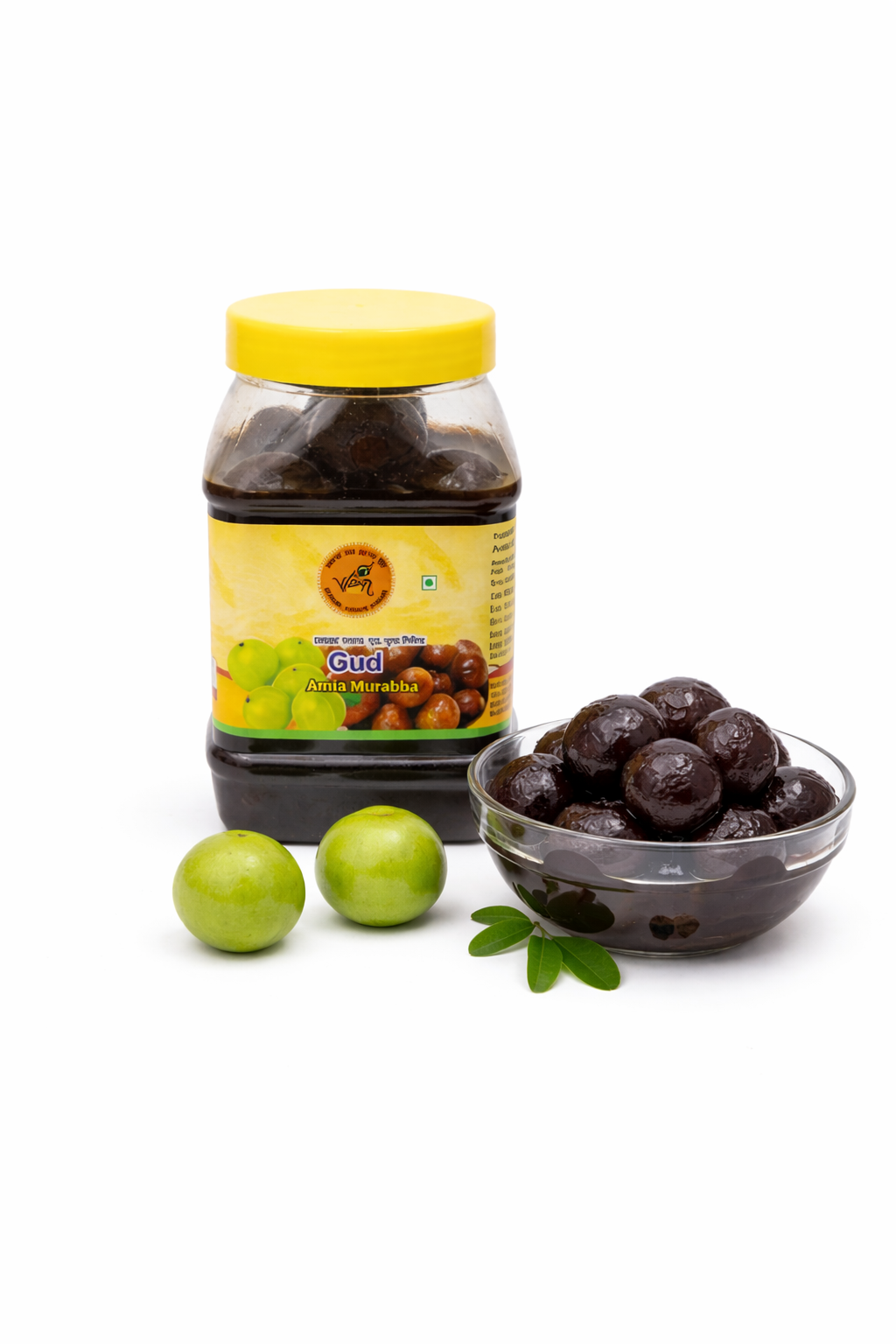
For our Murabba products — Gud Murabba and Cheeni Murabba — jaggery and sugar genuinely produce different products, not just different health profiles. The Gud Murabba has an earthier, more complex flavour; the Cheeni Murabba is cleaner and lighter.
Our position: both are legitimate choices. Jaggery is nutritionally preferable. Sugar sometimes allows cleaner fruit flavours. Neither makes our sweets "sugar-free" and we won't pretend otherwise.
See our Heritage page for more on ingredient philosophy, and our post on Organic Sweets in India for broader context.
How to Tell Real Jaggery from Industrial — 3 Tests
1. Colour: Traditional jaggery is deep brown to near-black. Bright yellow or pale jaggery has been chemically treated.
2. Taste: Real jaggery has complex flavour — sweet, slightly bitter, with a clear molasses note. If it tastes like slightly caramelized sugar without other complexity, it's been over-refined.
3. Texture: Traditional block jaggery is dense, slightly crumbly. If it's perfectly smooth and uniform like a moulded product, industrial processing is likely.
Best Jaggery Sweets in Haridwar
At Vrindavan Aushadhiya Misthan — the best sweet shop in Haridwar for jaggery-based traditional sweets:
- Gud Murabba: Amla preserved in jaggery syrup. The iron from jaggery combines with amla's Vitamin C, which dramatically improves iron absorption — a classical Ayurvedic combination.
- Amla Candy (Jaggery variant): Our dry amla candy made with jaggery instead of sugar.
- Guava Burfi (Jaggery variant): Darker, more complex flavour than the sugar version.
- Bael Barfi (Jaggery variant): Jaggery's earthiness pairs naturally with bael's own earthy, slightly medicinal character.
Visit our Bhandar page for the complete range.
Jwalapur Store (D-10), Subhash Nagar, Haridwar | B-13, B Cluster, BHEL | Navoday Nagar, near Butterfly School Gate No. 2
Hours: 8 AM to 9 PM | WhatsApp: +91-7705072989
FAQ: Jaggery Questions
Q1. If jaggery has more iron, why doesn't everyone switch? Primarily flavour — jaggery's strong taste changes delicate sweets. Also: sugar has a century of industrial marketing behind it. Jaggery is traditional and regional, with no equivalent commercial promotion.
Q2. Is brown sugar the same as jaggery? No. Brown sugar is refined white sugar with molasses added back in controlled quantities. Different process, different mineral profile — though preferable to white sugar.
Q3. Can pregnant women eat jaggery? Yes — jaggery is commonly recommended in Ayurveda during pregnancy specifically for its iron content. Overall sugar intake should remain moderate. Consult your doctor for specific guidance.
Q4. Does cooking jaggery reduce its nutritional benefit? High heat reduces some molasses phenol content. The mineral content — iron, magnesium — is largely heat-stable. Cooked jaggery retains most of its mineral advantage over white sugar.
Q5. Why does some jaggery taste bitter? Bitterness indicates higher molasses content — a sign of less processing and more authentic production. If you're not used to it, start with lighter variants.
Q6. Which is better for children? For regular household use, jaggery is preferable for the mineral content. But total sugar intake in children should be moderated regardless of sweetener. Building a taste for less-sweet food early is more valuable than optimising which sweetener is used.
Vrindavan Aushadhiya Misthan — the best sweet shop in Haridwar for jaggery and sugar variants of traditional herbal sweets. 3 locations | Open 8 AM to 9 PM | WhatsApp: +91-7705072989
गुड़ बनाम चीनी — ईमानदार आयुर्वेदिक दृष्टिकोण
वृंदावन औषधीय मिष्ठान टीम
इंटरनेट हर कुछ महीनों में गुड़ को "खोज" लेता है। एक तरफ से कहते हैं — गुड़ स्वास्थ्यवर्धक है, चीनी ज़हर है। दूसरी तरफ से न्यूट्रिशनिस्ट कहते हैं — दोनों में खास फर्क नहीं।
सच्चाई इन दोनों के बीच कहीं है।
चरक संहिता में गुड़ और शर्करा
गुड़: गुरु, स्निग्ध, रक्तप्रसादक — भारी, स्नेहयुक्त, रक्त निर्माण में सहायक। श्वास, कास में उपयुक्त। पुराण गुड़ (पुराना गुड़) ज़्यादा लाभकारी।
शर्करा: लघु, शीत, पित्त-शामक — हल्की, ठंडी, ज्वर में उपयुक्त। लेकिन अधिक मात्रा में क्लेद-कारक — शरीर में आर्द्रता और अवरोध।
चरक ने दोनों को उपयोगी माना — समस्या अति-उपभोग में है।
पोषण तुलना
| कारक | गुड़ (100 ग्राम) | सफेद चीनी (100 ग्राम) |
|---|---|---|
| कैलोरी | ~383 | ~387 |
| सुक्रोज | 65–85% | 99.7% |
| लोहा | 11 मिलीग्राम | नगण्य |
| मैग्नीशियम | 70–90 मिलीग्राम | 0 |
| पोटेशियम | 1,050 मिलीग्राम | 2 मिलीग्राम |
| ग्लाइसेमिक इंडेक्स | ~50–55 | ~65–70 |
कैलोरी लगभग बराबर है — वजन कम करना हो तो गुड़ मदद नहीं करता। लेकिन खनिज सामग्री में बड़ा फर्क है। 100g गुड़ में दैनिक लोहे की ~61% ज़रूरत पूरी होती है।
5 गुड़ के बारे में मिथक
- गुड़ शुगर-फ्री है — गलत। 65–85% सुक्रोज है
- मधुमेह में बेझिझक खाएँ — गलत। रक्त शर्करा बढ़ाता है, बस धीरे
- चीनी जितना ही पौष्टिक — गलत। खनिज में बड़ा अंतर
- सब गुड़ पारंपरिक है — गलत। अधिकांश बाज़ारू गुड़ रसायनों से साफ किया हुआ
- गुड़ से स्वास्थ्य समस्याएँ ठीक होंगी — अतिशयोक्ति
वृंदावन औषधीय दोनों विकल्प क्यों देती है?
गुड़ का मजबूत स्वाद कुछ उत्पादों में फल की नज़ाकत को दबा सकता है। कुछ ग्राहक साफ मिठास चाहते हैं। हम ईमानदारी से दोनों विकल्प देते हैं — कोई एक सही, कोई एक गलत नहीं।
हमारे गुड़ उत्पाद:
- गुड़ मुरब्बा — आंवला + गुड़ = विटामिन C + लोहा = श्रेष्ठ संयोजन
- गुड़ आंवला कैंडी | गुड़ अमरूद बर्फी | गुड़ बेल बर्फी
हरिद्वार की सर्वश्रेष्ठ मिठाई दुकान — वृंदावन औषधीय मिष्ठान: ज्वालापुर D-10 | B-13, BHEL | नवोदय नगर सुबह 8 – रात 9 | WhatsApp: +91-7705072989
Vrindavan Aushadhiya Misthan — 3 Locations, Haridwar
W3QF+4M Haridwar, Uttarakhand
Visit the Best Sweets Shop in Haridwar
Vrindavan Aushadhiya Misthan — 3 Store Locations · WhatsApp Delivery Available